DISEC · Disarmament & International Security

DISEC — The Strait of Hormuz

Research Material

Research Report Incoming

The background guide for this committee is currently being prepared by the Secretariat. It will be published here ahead of the conference.

DISEC Background Guide Coming soon

Topic Background

The Strait of Hormuz is the narrow maritime corridor between the Persian Gulf and the Gulf of Oman through which roughly one-fifth of global oil supply transits each day. At its narrowest point it is just 33 kilometres wide, with the shipping lanes themselves only a few kilometres across. No global chokepoint carries comparable economic and strategic weight.

Recent years have seen repeated incidents — tanker seizures, limpet-mine attacks, GPS spoofing, and the harassment of commercial vessels by uniformed and irregular naval forces. Iran, Oman, the United Arab Emirates, and the United States Fifth Fleet operate in close proximity, and a single miscalculation could threaten freedom of navigation, energy markets, and the marine environment of a semi-enclosed sea.

Delegates are expected to weigh the right of innocent passage under UNCLOS against legitimate coastal-state security interests, propose mechanisms for de-escalation, and consider how the international community can safeguard a waterway no single state controls.

Key Questions

  • How can the international community guarantee freedom of navigation without militarising the strait further?
  • What role should regional bodies — the GCC, the Arab League, the IMO — play in incident response?
  • How should attacks on commercial shipping by state and non-state actors be attributed and addressed?
  • What environmental safeguards are needed given the strait's fragile ecosystem and high tanker density?

Suggested Research

  • UNCLOS Articles 17–26 (innocent passage) and Article 38 (transit passage through straits)
  • IMO Maritime Safety Committee reports on the Gulf of Oman incidents (2019–present)
  • EMASOH (European-led Maritime Awareness in the Strait of Hormuz) mission and the US-led IMSC
  • Iran's official position papers on Hormuz security and the 1975 Treaty of Algiers

Bloc Dynamics

Expect natural tension between Iran and the Gulf Cooperation Council, with the United States, United Kingdom, and France pushing for multilateral patrols and Russia and China preferring regional-only frameworks. Smaller maritime nations — Norway, Singapore, the Netherlands — often hold the deciding voice on freedom-of-navigation language, given the size of their commercial fleets.


SOCHUM · Social, Humanitarian & Cultural Committee

SOCHUM — Surveillance Satellites

Earth viewed from a surveillance satellite
Research Material

Research Report Incoming

The background guide for this committee is currently being prepared by the Secretariat. It will be published here ahead of the conference.

SOCHUM Background Guide Coming soon

Topic Background

More than 11,000 active satellites now orbit the Earth, and a growing share carry imaging, signals-intelligence, or radar payloads capable of resolving objects on the ground to within tens of centimetres. Once the exclusive province of a handful of states, surveillance from orbit is now offered as a commercial service — with imagery sold to governments, journalists, NGOs, and private parties alike.

The 1967 Outer Space Treaty established that space is the province of all humankind, but it predates almost every capability now in routine use. There is no binding international regime that distinguishes peaceful Earth-observation from military surveillance, governs the dual-use commercial sector, or protects civilians whose lives, homes, and movements are observed without their knowledge or consent.

SOCHUM is asked to address the human dimension: privacy, the protection of civilians in conflict zones, the rights of indigenous and displaced communities, and the obligations of states whose private companies operate the systems.

Key Questions

  • How should the principle of "peaceful purposes" in the Outer Space Treaty be interpreted in the age of high-resolution commercial imaging?
  • What rights, if any, do civilians have to be free from continuous surveillance from orbit?
  • How can dual-use commercial operators be regulated without stifling legitimate scientific and humanitarian uses?
  • What mechanisms — transparency registers, sunset clauses, third-party audits — could verify state compliance?

Suggested Research

  • The 1967 Outer Space Treaty and the 1976 Registration Convention
  • UN Office for Outer Space Affairs (UNOOSA) guidelines on long-term sustainability
  • EU Space Strategy for Security and Defence (2023) and comparable national doctrines
  • Reports of the UN Special Rapporteur on the right to privacy on remote-sensing technology

Country Focus

The United States, Russia, China, India, France, Israel, and Japan operate the largest fleets of dedicated military or dual-use observation satellites. A second tier of states — Norway, Germany, the UAE, South Korea — shapes outcomes through commercial partners. Small states without orbital capability often advocate strongest for binding rules.

ECOSOC · Economic & Social Council

ECOSOC — Strengthening International Cooperation on the Global Refugee Crisis

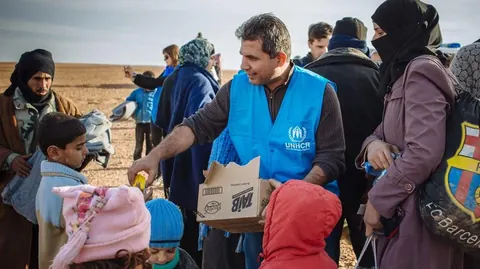
Refugees and displaced persons
Research Material

Research Report Incoming

The background guide for this committee is currently being prepared by the Secretariat. It will be published here ahead of the conference.

ECOSOC Background Guide Coming soon

Topic Background

More than 120 million people are now forcibly displaced — the highest figure ever recorded by UNHCR — and the rate of growth has outstripped every multilateral funding cycle of the past decade. Conflict in Sudan, Ukraine, Syria, Myanmar, and the Sahel accounts for the bulk of new movement, while climate-driven displacement is rising sharply across South Asia, the Pacific, and Central America.

The 1951 Refugee Convention and its 1967 Protocol remain the cornerstone of international protection, but they were drafted for a different world. They do not recognise climate refugees, place no binding obligation on third-country resettlement, and offer little guidance on the situation of people displaced for years or decades inside neighbouring host countries — Lebanon, Bangladesh, Jordan, Uganda, Colombia — whose own social systems are severely strained.

ECOSOC is asked to consider how the international community can share responsibility more equitably, address root causes rather than symptoms, and uphold dignity for displaced persons whether they return, integrate, or resettle.

Key Questions

  • How can UNHCR funding be stabilised against year-on-year shortfalls of 40–60%?
  • What new instruments — formal or informal — could recognise and protect climate-displaced persons?
  • How can the burden on host countries in the Global South be matched with meaningful resettlement commitments from wealthy states?
  • What conditions must be in place before voluntary return becomes a safe and durable solution?

Suggested Research

  • UNHCR Global Trends report (most recent edition) and the Global Compact on Refugees
  • The Comprehensive Refugee Response Framework (CRRF) and country pilot outcomes
  • IOM data on climate-related displacement and the Nansen Initiative recommendations
  • OECD Development Co-operation reports on refugee aid spending and burden-sharing

Bloc Dynamics

Major donors (the United States, the European Union, Japan, Norway, Canada) hold the resources but increasingly tighten domestic asylum policy. Major host states (Türkiye, Pakistan, Iran, Uganda, Colombia, Lebanon, Bangladesh) demand tangible burden-sharing. Small island and climate-exposed states push hardest for legal recognition of climate displacement.

Ready to debate?

Register for AKAMUN 2026